

Run this: a sub-5-minute automated intake touch, a Day 1 micro-cadence across text, email, and phone, then a 12 to 18 month nurture track for anyone who isn't ready yet. That's the whole system. Agents who respond inside five minutes convert far more of their internet leads into contacts than agents who wait even 15 minutes, because interest decays fast and the next agent's text is already landing in that lead's inbox.
Here's your 15-minute starter, right now, before you read another word:
- Turn on an auto-SMS or auto-reply in your CRM that fires the second a lead submits a form or calls and hangs up
- Create a Day 1 task template that auto-assigns to whoever's on intake duty
- Set a rule that any lead untouched after 10 minutes escalates to a manager alert
That's it. Everything below builds on those three moves.
Key Takeaways
The single most reliable predictor of real estate lead conversion is response speed inside the first five minutes, sustained by a structured multi-channel cadence over the following 90 days.
| Point | Details |
|---|---|
| Respond in under 5 minutes | Contact rates drop sharply once response time passes 15 minutes, so automate the first touch. |
| Run the 14-day cadence | Rotate text, email, and phone across 8 to 12 touches before easing into weekly, then monthly, follow-up. |
| Qualify with three questions | Timeline, current agent status, and lender status determine hot, warm, or long-term routing. |
| Automate CRM triggers | Behavioral signals like listing clicks should reprioritize leads automatically, not wait for a scheduled check-in. |
| Consider managed AI for scale | Leadclarifyai's AI Receptionist and Follow-Up Agents cover missed calls and cadence enforcement when volume outpaces a manual team. |
Table of Contents
- Building Your Real Estate Lead Follow-Up Cadence for the First 90 Days
- Which Channels Work Best for Real Estate Lead Follow-Up?
- What Questions Qualify a Real Estate Lead Fast?
- How Do You Set Up CRM Automation to Enforce the Cadence?
- How Do You Keep Long-Term Leads Engaged Without Wasting Time?
- What KPIs Actually Show Whether Follow-Up Is Working?
- Copy-Ready Templates and a Morning Routine for Lead Follow-Up
- When Does Managed AI Follow-Up Make Sense for a Brokerage?
- What the Data Actually Says About Follow-Up Discipline
- Get Your Follow-Up System Running Without Building It Yourself
- Frequently Asked Questions About Real Estate Lead Follow-Up
- Sources
Building Your Real Estate Lead Follow-Up Cadence for the First 90 Days
Speed gets you the first contact. Cadence gets you the appointment. Most agents lose leads not because they never followed up, but because they followed up twice and quit. High-converting agents run 8 to 12 touches across the first two weeks alone, rotating channels so no single message feels like nagging.
The first 14 days:
- Day 0: Auto-text within 5 minutes, followed by a personal call attempt within 15 minutes and a same-day email if no answer.
- Day 1: Second call attempt, plus a short value-add text (a listing match or market note).
- Day 2: Email with 2 to 3 relevant listings tied to their stated criteria.
- Day 3: Text check-in, one direct question ("Still looking in [neighborhood]?").
- Day 5: Value email, market update or a "what buyers are seeing right now" note.
- Day 7: Close-the-loop call or voicemail plus text.
- Day 10: Email with a new angle, financing tip or neighborhood comparison.
- Day 14: Direct ask, text or call, "Want to grab 15 minutes this week?"
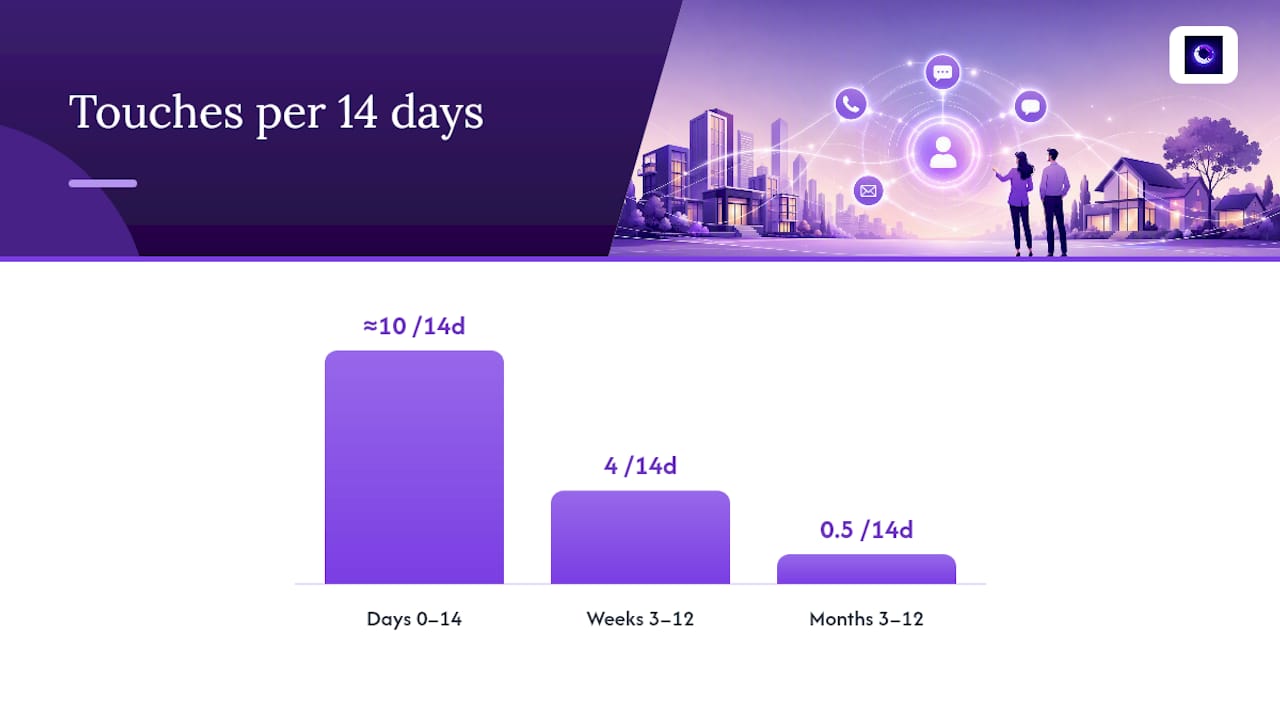
After day 14, cadence loosens. Weeks 3 through 12 move to twice-weekly touches, alternating call attempts with value emails. From month 3 onward, a monthly drip keeps the relationship alive without burning your time budget.
| Timeframe | Touch frequency | Primary goal |
|---|---|---|
| Days 0–14 | Daily or near-daily, 8–12 touches | Establish contact, confirm timeline |
| Weeks 3–12 | 2x per week | Book a showing or consultation |
| Months 3–12 | Monthly | Stay top of mind, catch reactivation signals |
On Day 90, send a breakup email: something honest, like "I'll stop reaching out unless you tell me you're still looking." This single message reliably reactivates a portion of stalled leads because it removes pressure and gives the lead permission to respond on their own terms. Leads who reply move back to active cadence. Everyone else drops into the long-term nurture track.
Which Channels Work Best for Real Estate Lead Follow-Up?
Text gets read in minutes. Email carries depth and listings. Phone builds trust fast, when someone actually answers. The right sequence uses all three, not because more channels means more noise, but because different leads respond to different formats at different moments in their search.

Use text for anything time-sensitive or low-friction: confirming a showing, checking if they're still interested, sending a quick listing link. Use email when you need to deliver something substantial, like a market report or a set of matched listings. Use phone for qualification and for closing the loop, because tone and pacing do work that text simply can't.
A few micro-templates that consistently earn replies:
- SMS opener: "Hi [Name], this is [Agent] with [Brokerage]. Saw you're interested in [neighborhood/property]. Still actively looking?"
- One-question follow-up: "Quick one, are you working with an agent already, or still shopping around?"
- Email subject line: "3 homes that match what you're looking for in [neighborhood]"
- First email opener: "I pulled together a few listings based on what you told us, take a look and let me know which ones you'd want to see in person."
- Voicemail script: "Hey [Name], it's [Agent] with [Brokerage]. I've got a couple of homes that fit what you described. Call or text me back at [number], happy to send them over either way."
- Breakup email subject: "Should I close your file?"
Pro Tip: Never send the exact same template twice to the same lead. Swap one detail (a new listing, a fresh market stat, a different question) so each touch feels like it was written for that specific person, not blasted to a list.
What Questions Qualify a Real Estate Lead Fast?
Three questions do most of the work: What's your timeline? Are you working with an agent already? Have you talked to a lender? The answers tell you exactly which track a lead belongs on and how urgently you need to move.
- Hot leads: Ready to buy or sell within 30 days, pre-approved or has a lender relationship, not tied to another agent. Route directly to a showing or listing appointment, and call rather than text.
- Warm leads: Interested but 1 to 6 months out, still shopping lenders or deciding on a neighborhood. Keep them on the intensive 14-day cadence, but don't push for a meeting yet.
- Long-term leads: No firm timeline, "just looking," or 6+ months from acting. Move them into monthly nurture immediately rather than burning daily touches on someone who isn't close.
On a team, hot leads should go to whoever can respond fastest, often a dedicated intake person or a real estate appointment setter rather than the listing agent buried in paperwork. Warm and long-term leads can sit in a shared nurture queue.
How Do You Set Up CRM Automation to Enforce the Cadence?
Your CRM should fire the Day 1 sequence without anyone remembering to click a button. If a human has to initiate every touch, the cadence eventually breaks down during a busy week, and that's exactly when leads go cold.
- Build the trigger. New lead enters CRM (form fill, call, text) triggers an instant auto-SMS and creates a Day 1 task assigned to intake.
- Layer in behavioral scoring. A lead who opens three emails or clicks into a listing twice should jump priority, moving from warm to hot automatically rather than waiting for a scheduled check-in.
- Sync your calendar. Showing requests and appointment confirmations should write directly to your booking system, no manual back-and-forth.
- Route webforms correctly. Leads from Zillow, your website, and open-house sign-ins should land in the same pipeline with source tags intact, not scattered across separate inboxes.
- Capture call outcomes. Every call attempt, answered or not, gets logged with a one-line note. This is what makes your KPI reporting accurate later.
Treating your CRM as an intelligence hub, not just a contact list, matters more than the platform you pick. A lead who clicked into a specific listing twice this week is telling you something a static drip schedule will miss entirely.
Pro Tip: If your CRM can't auto-fire a task within 60 seconds of a new lead entering the system, you're leaving contact-rate percentage points on the table before you've even said hello.
How Do You Keep Long-Term Leads Engaged Without Wasting Time?
Long-term leads don't need daily attention, they need relevance delivered on a schedule you barely have to think about. Monthly touches work, as long as each one carries something useful.
- Neighborhood briefs: new listings, price trends, school updates for their target area
- Market updates: a short "here's what happened this month" note, no sales pitch attached
- Listing matches: an automated alert when something hits that fits their saved criteria
Add a personal note every 45 to 90 days, something specific to their situation, not another template. That single human touch inside an otherwise automated drip is what separates a nurture sequence that converts from one that gets marked as spam.
Watch for reactivation signals: multiple email opens in one week, a click into a listing, a reply to any drip message. Any of these should immediately pull the lead back into your active 14-day cadence.

What KPIs Actually Show Whether Follow-Up Is Working?
Four numbers tell you almost everything: speed-to-lead (time to first contact attempt), contact rate (percentage of leads you actually reach), attempts per lead before contact, and conversion rate by source.
Pro Tip: Structured teams with a dedicated intake role convert 5 to 10 percent of internet leads, while solo agents working leads alone typically land in the 1.5 to 3 percent range. If your numbers sit below that solo-agent floor, the gap usually isn't lead quality, it's follow-up consistency.
Track these weekly, not monthly. If your speed-to-lead average creeps past 10 minutes, that alone can explain a soft month. If contact rate is high but conversion is low, your qualification questions or your pitch need work, not your response time. Log every outcome (contacted, no answer, appointment set, dead) so your CRM can spit out a prioritized call list each morning ranked by urgency and lead score.
Copy-Ready Templates and a Morning Routine for Lead Follow-Up
Paste these into your CRM today.
- Day 0 checklist: Auto-SMS fires, call attempt within 15 minutes, task logged, source tagged.
- Day 1 checklist: Second call attempt, value text sent, email queued with matched listings.
- Morning routine (10 minutes): Pull your CRM's prioritized list, hot leads first, then yesterday's no-answers, then scheduled nurture touches.
- SMS template: "Hi [Name], following up on [property/area]. Any questions I can answer?"
- Email template: Subject: "New match for your search in [neighborhood]." Body: three listings, one sentence each, one clear call to action.
- Voicemail template: Name, brokerage, one specific reason for the call, callback number stated twice.
Keep these in a shared doc your whole team can edit, because a script that stops converting needs to get rewritten, not repeated forever.
When Does Managed AI Follow-Up Make Sense for a Brokerage?
Manual cadences work until lead volume outpaces the humans running them. That's usually the exact moment brokerages start losing the leads they paid the most to generate, missed calls during showings, unanswered after-hours inquiries, old database leads nobody ever reactivates.
Leadclarifyai builds the infrastructure around that gap instead of asking your team to execute it manually. The AI Receptionist covers inbound and missed calls around the clock, the Appointment Setter qualifies and books directly into your calendar, and the AI Follow-Up Agents run the multi-channel cadence (text, email, voice) triggered by exactly the events described above: a form fill, a missed call, a stalled lead.
- Best fit: teams with lead volume that already outpaces consistent manual follow-up
- Best fit: brokerages losing leads to slow after-hours response
- Less critical fit: a single agent with a small, easily manageable pipeline
Managed AI follow-up doesn't replace the qualifying conversation, it makes sure that conversation actually happens instead of getting lost in a Tuesday afternoon that got away from everyone.
What the Data Actually Says About Follow-Up Discipline
Most follow-up advice focuses on what to say. That's backward. The agents converting at 5 to 10 percent aren't winning because their text messages are clever, they're winning because they built a pipeline where speed and persistence happen by default, not by memory.
The conventional wisdom oversells personality and undersells infrastructure. A charming agent with no system loses to an average agent with a 5-minute auto-response and a logged 14-day cadence, every time, because the lead has usually moved on emotionally before the charming agent even picks up the phone.
If you take one thing from this guide, prioritize the trigger before the template. A perfect script sent on Day 6 instead of Day 0 already lost. Build the automated intake first, then worry about whether your voicemail script sounds natural. And when your volume outgrows what your team can execute by hand, that's not a discipline problem anymore, that's an infrastructure problem, and it needs an infrastructure answer.
Get Your Follow-Up System Running Without Building It Yourself
Everything in this guide works, but running it manually, day 0 through day 90, across text, email, and phone, for every lead source, is a full-time job most agents don't have room for. Leadclarifyai installs that exact infrastructure: an AI Receptionist that catches every missed call, an AI Appointment Setter that books directly into your calendar, and AI Follow-Up Agents that run the multi-channel cadence automatically, triggered the moment a lead comes in or goes quiet.
Instead of hoping your team remembers Day 3 and Day 10, the system fires on schedule every time, then hands off to a human the moment a lead is ready to talk. If your pipeline has outgrown what manual follow-up can cover, see how Leadclarifyai's AI infrastructure works and get a plan built around your current lead volume.
Frequently Asked Questions About Real Estate Lead Follow-Up
How fast should I respond to a new real estate lead? Aim for under five minutes. Contact probability drops sharply once you cross the 15-minute mark, so an automated first touch matters more than a perfectly worded one.
How many follow-up attempts does a real estate lead actually need? Plan for 8 to 12 touches across the first two weeks, rotating text, email, and phone, rather than three or four attempts spread over a month.
What should I say in a breakup email to a cold real estate lead? Keep it short and honest: tell them you'll stop reaching out unless they confirm they're still interested. This kind of message often reactivates leads who went quiet simply because the pressure was removed.
Should solo agents automate lead follow-up or do it manually? Automate the intake and Day 1 touch at minimum. Structured teams with automated cadences convert several times more internet leads than agents relying on memory and manual outreach.
How do I know if a lead is worth prioritizing today? Ask about timeline, whether they're working with another agent, and lender status. Anyone ready within 30 days with financing in place goes to the top of your call list immediately.
Sources
For benchmark data on contact rates and conversion by team structure, see the speed to lead study and conversion rate benchmark from ConversionRealtor. For channel strategy and cadence templates, Realtor.com's conversion techniques guide is the strongest starting point. For a full day-by-day 90-day schedule, reference Serif's lead follow-up plan.